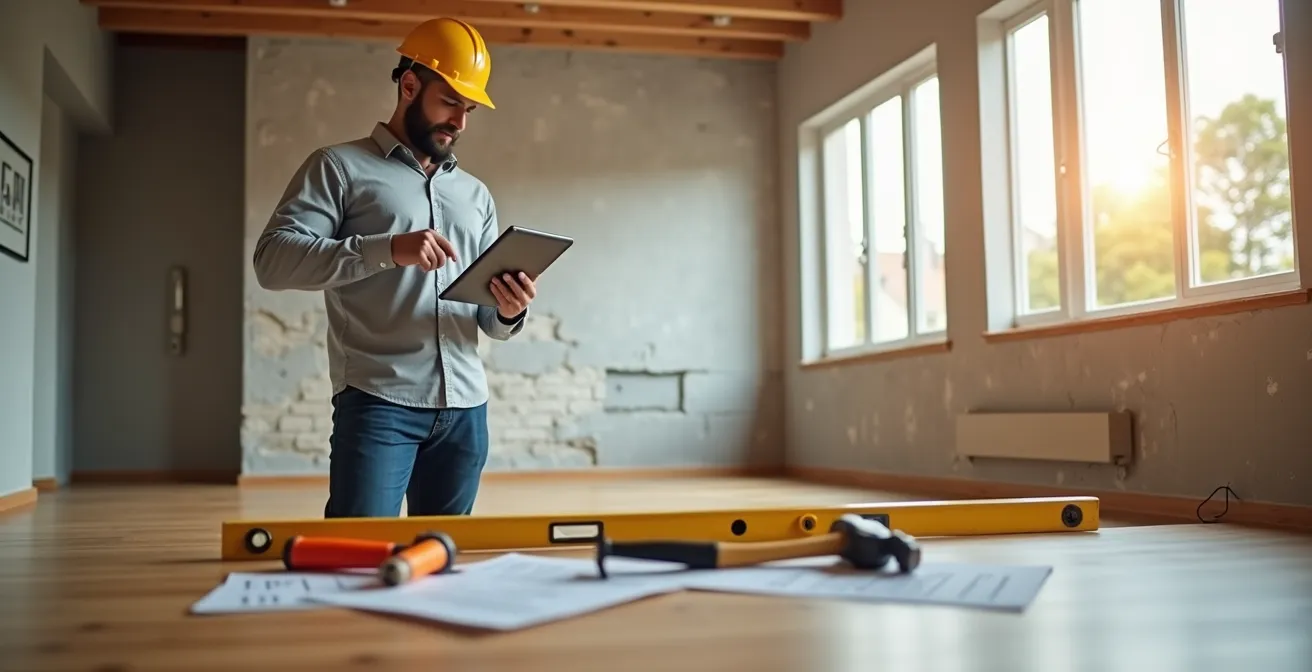
Home service franchises don’t just survive downturns; they thrive by shifting from discretionary wants to non-negotiable needs.
- In a tight economy, homeowner spending pivots to essential repairs and asset protection, not luxury remodels.
- True resilience isn’t guaranteed by a brand name; it’s forged through superior operational efficiency and savvy financial management.
Recommendation: Before investing, scrutinize the franchisor’s operational playbook and support systems—that’s where the real value lies.
When the economy tightens its grip, investors get nervous. Discretionary spending evaporates, and businesses built on “wants” instead of “needs” are the first to feel the squeeze. The common wisdom is that home improvement franchises are “recession-resistant,” a safe harbor in a financial storm. There’s truth to that. People will always need a plumber for a burst pipe or an electrician for a dead outlet. The fundamental demand for maintaining one’s most significant asset—their home—doesn’t disappear.
But banking on this fact alone is a rookie mistake. The idea that you can just buy a franchise, slap a logo on a van, and watch the cash roll in regardless of the economic climate is a fantasy. The resilience of this sector isn’t automatic; it’s earned. It’s forged in the trenches of day-to-day operations, where smart decisions about staffing, marketing, and customer service separate the survivors from the casualties. The franchise brand provides a playbook, but winning the game requires operational grit.
This isn’t about simply weathering the storm. It’s about understanding how the storm changes the landscape. Homeowner priorities shift from ambitious kitchen remodels to critical repairs and efficiency upgrades. Lead generation tactics that worked in a boom market fall flat. The real key to thriving during a downturn is not just being an “essential service” but mastering the unglamorous, behind-the-scenes mechanics of the business. This guide digs into the tough questions and practical realities of what it actually takes to build a home service franchise that lasts.
To give you a clear roadmap, this article breaks down the core operational challenges and strategic decisions that determine success. The following sections tackle the real-world problems you’ll face as a franchise owner, from managing your workforce to winning leads when budgets are tight.
Summary: The Real Reasons Home Service Franchises Outlast Recessions
- How to Survive the Winter Slump in Exterior Home Improvement Franchises?
- Subcontractors or W2 Employees: Which Model Protects Your Quality Standards?
- SEO vs Direct Mail: What Actually Generates Leads for Home Services Today?
- The “Unsatisfied Homeowner” Nightmare: How to Resolve Disputes Without Court?
- When to Lease vs Buy Your Service Vans to Optimize Tax Deductions?
- National Contracts vs Local Fixers: Who Responds Faster on a Sunday Night?
- How to Negotiate Rent Abatement in Premium Malls During Construction?
- The Cost of Neglect: Why Skipping a $200 Service Call Could Cost You a $5,000 Compressor?
How to Survive the Winter Slump in Exterior Home Improvement Franchises?
The winter slump is a reality for any business focused on exterior work like roofing, siding, or landscaping. The weather doesn’t care about your revenue goals. Acknowledging this seasonality isn’t weakness; it’s the first step in building a business that’s profitable year-round. The key is to stop thinking of yourself as a “siding guy” and start thinking like a “home solutions provider.” When the ground is frozen, the work moves indoors. This isn’t just about finding busy work; it’s a strategic pivot to capture a different slice of the homeowner’s budget.
During a downturn, homeowners are even more focused on cost-effective projects. Research shows that while big-ticket remodels might get postponed, projects like interior painting, minor bathroom updates, and flooring replacements remain popular. These are services that can be executed regardless of the season. Offering a diversified menu of services makes your franchise a one-stop shop, increasing customer lifetime value and insulating your cash flow from the calendar. The U.S. residential remodeling market is a massive playground, with an estimated value that shows its fundamental strength even in uncertain times.
The strategy is simple: follow the work. In the spring and summer, you’re outside. In the fall, you’re marketing gutter cleaning and winterization services. In the winter, your crews are inside painting, installing new fixtures, or handling the backlog of smaller repairs that homeowners put off. This requires cross-training your teams and having a marketing plan that shifts its focus with the seasons. It turns a potential liability into a competitive advantage, ensuring your best people stay busy and your brand stays top-of-mind all year.
Ultimately, surviving the winter is about proactive planning, not reactive scrambling. By building a business model that anticipates and adapts to seasonal changes, you create a more stable, resilient, and profitable operation.
Subcontractors or W2 Employees: Which Model Protects Your Quality Standards?
This is one of the most critical decisions you’ll make, and it goes right to the heart of your brand’s promise. On the surface, using subcontractors seems like a no-brainer. You get flexibility, lower overhead, and no long-term commitments. You pay for the job, not for the person. In a boom market, this can work. But when the economy gets tough and every job counts, the cracks in the subcontractor model start to show. The bottom line is that you can’t control what you don’t own. A subcontractor’s loyalty is to their own business, not yours. Their priority is their next job, not your customer’s satisfaction.
W2 employees, on the other hand, are an investment in your brand. You’re responsible for their training, their equipment, and their schedule. It costs more upfront, but what you buy is control and consistency. You can mandate the quality of work, the uniform they wear, and the way they speak to a customer. This isn’t micromanagement; it’s brand protection. As experts from Neighborly Franchise Systems note, “Franchise owners can often expect a steady stream of customers, even during economic downturns, as people will always need help maintaining and repairing their homes.” That steady stream only continues if the quality of service is unwavering. W2 employees are the most reliable way to guarantee that quality.
The visual of a professional’s tools says it all. The precision and care required for high-quality home services demand a dedicated, well-trained team that operates as a single unit, not a loose collection of freelancers.

Ultimately, the choice reflects your business philosophy. If you’re building a business for the long haul, investing in a W2 workforce is investing in your reputation. Your employees become the face of your company, the guarantors of your promise. In a downturn, when trust is the most valuable currency, a reliable, professional team is a non-negotiable asset that subcontractors simply cannot replicate.
Think of it this way: subcontractors are a short-term solution for a labor problem, while W2 employees are a long-term solution for a quality and brand problem. In a tough market, your brand is all you have.
SEO vs Direct Mail: What Actually Generates Leads for Home Services Today?
Lead generation isn’t a one-size-fits-all game, especially when customer anxiety is high. The old debate between digital and traditional marketing misses the point. The right tool depends on the customer’s mindset. Are they in a panic because a pipe burst, or are they leisurely dreaming about a new deck? The intent behind the search dictates the channel. During an economic downturn, the mix of these intents changes dramatically. While some homeowners pause big projects, recent data shows the impact, with a survey from MarketSharp indicating that 46% of home remodelers reported a decline in demand correlating with economic shifts.
This is where a hybrid strategy becomes critical. You need to be present in both the “need it now” and “thinking about it later” spaces. The following table breaks down how these channels serve different purposes, particularly in a shifting economy.
| Marketing Channel | Lead Type | Best Use Case | Economic Climate Response |
|---|---|---|---|
| SEO/PPC | High-intent, emergency needs | Immediate repairs, urgent services | Cost-effective during downturns |
| Direct Mail | Non-urgent, high-consideration | Kitchen/bath remodels, major renovations | Better for creating demand |
| Hybrid QR Code Strategy | Cross-channel tracking | New homeowners, targeted demographics | Maximizes both channels |
During a recession, the volume of high-intent, emergency searches often increases. Homeowners will delay a cosmetic upgrade, but they can’t ignore a leaking roof or a faulty furnace. This makes a strong Search Engine Optimization (SEO) and Pay-Per-Click (PPC) presence non-negotiable. You have to be the first result when someone frantically searches “emergency plumber near me.” This is about capturing existing, urgent demand, and it’s highly cost-effective.
Direct mail, on the other hand, is about creating future demand. It plants a seed for those larger, higher-ticket projects that may be on hold but not forgotten. It keeps your brand in the homeowner’s hands for when confidence returns. The smartest play is to integrate them. A direct mail piece with a QR code that leads to a project gallery or a special offer online bridges the gap, allowing you to track ROI and nurture a lead from a physical mailbox to a digital conversion.
The bottom line: don’t choose between SEO and direct mail. Understand their different roles. In a downturn, double down on SEO to capture the immediate needs, and use direct mail strategically to build your pipeline for the recovery.
The “Unsatisfied Homeowner” Nightmare: How to Resolve Disputes Without Court?
Nothing can cripple a home service business faster than a reputation for poor work and unresolved customer complaints. In the age of online reviews, a single “nightmare” story can undo months of marketing efforts. During an economic downturn, this danger is magnified. Customers are more stressed about their finances, more critical of every dollar spent, and more likely to voice their dissatisfaction publicly. Avoiding court isn’t just about saving legal fees; it’s about protecting your brand’s most valuable asset: trust.
The key to resolving disputes is preventing them from escalating in the first place. This requires a shift in mindset from project completion to proactive communication and expectation management. Most disputes don’t arise from a single major failure but from a series of small miscommunications and unaddressed concerns. Implementing a system of customer satisfaction checkpoints is crucial. This means getting formal sign-offs at critical project milestones—after demolition, after rough-in, before final paint. It forces communication and surfaces issues when they are small and easy to fix, not after the final invoice has been sent.
A professional, calm space for discussion can also de-escalate tension. Having a designated area with material samples and project plans allows for clear, fact-based conversations away from the “he said, she said” chaos of a job site.

When a dispute does occur, the process should be immediate and structured. First, listen without interrupting. Let the homeowner vent their frustration. Second, document everything with photos and notes. Third, separate the emotions from the facts. What is the specific, tangible issue? Finally, propose a clear, time-bound solution. Don’t make vague promises. Offer a concrete plan of action. This professionalism demonstrates that you take their concerns seriously and reinforces that you are a credible business, not a fly-by-night operator. Maintaining customer trust is paramount, as it’s the foundation of the continued patronage that helps a franchise survive tough times.
Resolving disputes without court isn’t about being a pushover. It’s about having a strong, repeatable process that protects your reputation, preserves customer relationships, and keeps your focus on profitable work, not costly legal battles.
When to Lease vs Buy Your Service Vans to Optimize Tax Deductions?
Your fleet of service vans isn’t just a way to get from job to job; it’s a critical financial lever. The decision to lease or buy is a strategic one that directly impacts your cash flow, your balance sheet, and your tax bill. There’s no single right answer—the best choice depends on your franchise’s stage of growth, your access to capital, and your appetite for risk. A practical investor looks at the numbers, and the numbers tell two different stories.
Leasing is a cash flow play. The upfront cost is minimal, and the monthly payments are typically lower than a loan payment. This frees up precious capital that can be invested in marketing, hiring, or other growth initiatives. Leasing also provides flexibility; you can easily upgrade your fleet every few years to newer, more reliable, and more fuel-efficient vehicles. The downside is that you’re essentially renting. You build no equity, and you’re often limited by mileage caps and wear-and-tear clauses.
Buying, on the other hand, is an asset-building play. The van becomes a tangible asset on your company’s books. While it requires more capital upfront, it gives you full control and, more importantly, significant tax advantages. Under current IRS guidelines, heavy vehicles used for business can be eligible for powerful deductions. For instance, a provision like Section 179 allows businesses to deduct the full purchase price of qualifying equipment. This can include significant tax advantages for commercial vehicle upgrades, which can dramatically lower your taxable income. This is a powerful tool for a profitable business looking to minimize its tax burden.
The decision boils down to a trade-off. Do you need to conserve cash and maintain flexibility (lease), or do you have the capital and profitability to leverage asset ownership for major tax benefits (buy)? For a new franchise, leasing often makes more sense to get operations off the ground. For an established, profitable franchise, buying can be a smarter long-term financial strategy, especially given the tax incentives.
Ultimately, consult with a tax professional, but go into that conversation understanding the strategic difference: leasing protects your cash, while buying can supercharge your tax deductions.
National Contracts vs Local Fixers: Who Responds Faster on a Sunday Night?
When a homeowner’s basement is flooding at 2 a.m., they don’t care about your national brand recognition or your clever marketing. They care about one thing: getting a qualified professional to their house, right now. This is the moment of truth where a home service franchise either proves its value or reveals itself as just a logo. The promise of a national network is superior systems and reliability. The reality often depends on how well that promise is executed at the local level.
A solo local fixer might be a great technician, but they’re a one-person show. If they’re on another job, sick, or on vacation, the homeowner is out of luck. Their “24/7 service” often means a voicemail that might get checked in the morning. A strong national franchise, however, should have the infrastructure to deliver on the 24/7 promise. This isn’t just about having an answering service; it’s about having a redundant, technology-driven system built for immediate response. The best franchises use integrated systems to ensure no call is missed and the closest available technician is dispatched automatically.
The goal is to build a system that eliminates human bottlenecks and guarantees a rapid response time, turning emergency service from a liability into a major differentiator. The following checklist outlines the key components of a truly effective emergency response system that a good franchise should provide.
Action Plan: Building a Bulletproof 24/7 Response System
- Implement 24/7 emergency services for critical incidents like water, mold, and property disasters through the franchise network’s infrastructure.
- Establish “follow-the-sun” call center routing across different time zones to ensure continuous, live availability without fail.
- Use GPS-based dispatching software to automatically route incoming emergency calls to the nearest qualified and available technician.
- Create and advertise guaranteed response time Service Level Agreements (SLAs) to clearly differentiate your franchise from independent contractors.
- Build redundancy through the franchise network, allowing nearby franchisees to provide backup coverage during peak demand or large-scale events.
This is where the power of the franchise model shines. No single independent operator can afford to build this level of infrastructure. By investing in a home service franchise, owners are tapping into a business model built to last, with the backing of established brands and proven systems. When a potential customer is choosing between a local fixer and your franchise for an emergency, a guaranteed, rapid response time is the most powerful selling point you can have.
In the end, speed and reliability win. A national brand that can deliver a local, expert response faster than the competition will dominate the lucrative emergency services market, especially when times are tough.
How to Negotiate Rent Abatement in Premium Malls During Construction?
While most home service franchises operate out of industrial parks or small offices, some models benefit from a retail-style showroom, especially for high-end services like kitchen and bath remodeling. Securing a location in a premium mall can provide incredible visibility, but the rent can be crippling, especially during the initial build-out phase when you have zero revenue. Negotiating rent abatement—a period where you pay reduced or no rent—isn’t about asking for a handout. It’s a strategic negotiation where you leverage your value to the landlord.
Landlords, especially in a soft economy, are focused on one thing: occupancy and foot traffic. An empty storefront is a liability. Your new, high-end showroom is a future asset that will attract desirable customers to their property. You are part of their solution. During the construction phase, you’re not just a tenant; you’re a partner in the mall’s future success. This is your primary point of leverage. You must frame your requests around mutual benefit, not just your own financial relief.
Several specific clauses and strategies can be used in your lease negotiation. Understanding these tools before you even talk to a landlord is critical. The following table outlines some of the most effective strategies for negotiating rent terms during a build-out.
| Strategy | Application | Success Rate | Best Timing |
|---|---|---|---|
| Co-Tenancy Clause | Trigger rent reduction when anchor tenants leave | High during downturns | Initial lease negotiation |
| Percentage Rent Model | Pay based on sales performance | Medium-High | Construction periods |
| Marketing Fund Contribution | Landlord contributes to reopening campaigns | Medium | Post-construction |
The “Percentage Rent” model is particularly powerful during construction. You propose to pay a small base rent plus a percentage of your sales. Since your sales are zero during build-out, your rent is minimal. It aligns your costs directly with your revenue and shows the landlord you’re confident in your future success. Another key point is the Tenant Improvement (TI) allowance. This is money the landlord provides to help you build out your space. A generous TI allowance can be even more valuable than rent abatement. The home improvement sector’s robust outlook, with projections suggesting the global franchise market could reach $15.72 billion by 2033, gives you a strong argument for why your franchise is a good bet for the landlord.
Remember, the initial lease you sign will dictate your fixed costs for years. A tough, smart negotiation upfront can save you hundreds of thousands of dollars over the life of the lease and is a cornerstone of a resilient business.
Key Takeaways
- In a downturn, homeowner spending shifts from luxury “wants” to essential “needs,” making repair and maintenance services critical.
- Franchise resilience is not automatic; it’s built on a foundation of operational grit, quality control, and superior customer service.
- Smart financial management, including savvy marketing allocation and vehicle financing, is what separates the winners from the losers when the economy is tight.
The Cost of Neglect: Why Skipping a $200 Service Call Could Cost You a $5,000 Compressor?
This is the core value proposition of any home service business, and it becomes even more powerful during an economic downturn. Homeowners transform from passive consumers into aggressive protectors of their most valuable asset. They understand that money is tight, and the last thing they can afford is a catastrophic, budget-destroying failure. Your marketing and sales message must shift from selling a service to selling “financial protection.” You’re not just fixing a furnace; you’re preventing a $5,000 replacement in the dead of winter.
The economics of preventive maintenance are brutally simple and highly persuasive. A small, predictable expense today eliminates a massive, unpredictable expense tomorrow. As one analysis points out, a $200 HVAC maintenance call can prevent an $8,000 system replacement, and a $150 plumbing inspection can help a homeowner avoid a $15,000 water damage disaster. This isn’t a scare tactic; it’s a financial reality that resonates deeply with a budget-conscious consumer. Your job is to clearly and consistently articulate this value proposition.
This concept of a “cascade failure”—where one small, neglected component leads to the destruction of an entire system—is something technicians see every day. Visualizing this progression can be a powerful tool to help homeowners understand the stakes.

In a tough economy, you are selling peace of mind. Your maintenance plans and routine service calls are an insurance policy against financial disaster. This message taps directly into the homeowner’s mindset of asset protection. With U.S. homeowners’ spending on projects reaching significant sums, as noted in a report by Neighborly, with an average of $12,050 spent on home projects in 2024, positioning your services as a way to protect that investment is a winning strategy. You’re not an expense; you’re the guardian of their home’s value and their family’s budget.
Frame every service call and maintenance plan in these terms. By shifting the conversation from cost to value and from expense to investment, you align your business directly with the homeowner’s priorities, ensuring a steady stream of work even when the economy is uncertain.
Frequently Asked Questions About Home Improvement Franchises
Why are home service franchises considered recession-proof?
They are considered resilient because they provide essential services. Regardless of economic conditions, homeowners still need to repair leaks, fix heating systems, and maintain the safety and functionality of their property. This creates a baseline of non-discretionary demand that helps insulate them from the worst effects of a downturn.
What makes dispute resolution critical during economic downturns?
During uncertain economic times, customer trust becomes paramount. Homeowners are more cautious with their spending and have higher expectations for the value they receive. A swift and fair resolution to any issue protects your brand’s reputation, encourages repeat business, and generates positive word-of-mouth referrals, which are all critical for survival and growth in a tight market.
How can franchises prevent disputes before they escalate?
The most effective method is proactive communication and process. Implementing mandatory customer satisfaction checkpoints at key project milestones allows issues to be identified and resolved early. Maintaining clear, consistent communication protocols ensures that homeowners feel heard and informed, which dramatically reduces the likelihood of small misunderstandings turning into major disputes.