
A non-compliant franchisee isn’t just a nuisance; they are a direct liability actively devaluing your personal investment by eroding the collective brand equity you both share.
- Inconsistent customer experiences and branding can slash potential revenue by over 20% and damage customer retention.
- The strength of the national brand directly impacts your business’s valuation multiple, meaning a weaker brand results in a significantly lower exit price for you.
Recommendation: Treat your franchise as a shared financial asset. Proactively address non-compliance through strategic, evidence-based reporting to protect your investment’s future value.
You’ve seen it. The franchise location in the next town over with the flickering sign, the peeling paint, or the staff that ignores the national “Two for One” Tuesday promotion. As a diligent operator who invests time and money to uphold brand standards, this isn’t just frustrating; it’s a direct threat to your bottom line. Many franchisees believe their business is an island, judged solely on its own four walls and P&L statement. This is a dangerous misconception. The reality is that we are all shareholders in a single, collective brand, and every weak link directly dilutes the value of our shared equity.
The standard advice revolves around following the operations manual or hoping the corporate office will intervene. But this passive approach fails to grasp the core of the problem. This isn’t about aesthetics or minor rule-breaking. It’s about asset protection. A “rogue shareholder”—a non-compliant franchisee—creates a brand experience that is unpredictable and untrustworthy. This inconsistency introduces risk in the mind of the customer, and financial markets punish risk by lowering asset valuations. Your neighbor’s sloppy operation isn’t just their problem; it’s a measurable liability that reduces your pricing power and, most critically, will lower your business’s final resale price.
This article reframes the conversation from brand compliance to brand equity valuation. We will dissect the financial mechanics of how one franchisee’s negligence systematically erodes the value of your hard-earned investment. We will move beyond complaining and equip you with a valuator’s mindset, exploring how to report issues constructively, quantify the value of brand consistency, and ultimately understand how a strong, unified brand presence is the single most important factor in maximizing your exit multiple. It’s time to stop seeing a dirty store as an annoyance and start seeing it for what it is: a direct withdrawal from your future financial security.
To navigate this complex issue, we’ve structured this guide to move from immediate, practical actions to the high-level financial principles that underpin your franchise’s value. The following sections will provide a clear roadmap for protecting your investment.
Summary: The Franchisee’s Dilemma: Protecting Your Investment from Brand Dilution
- The Snitch Line: How to Report Non-Compliant Franchisees Without Starting a War?
- The Logo Tax: Why Customers Pay 20% More for Your Burger Than the Generic Place?
- The Opt-Out Risk: Why Skipping the National Promo Confuses Your Local Customers?
- The Font Police: Why Using Comic Sans on Your Window Sign Damages the Brand?
- The Multiple Boost: How Strong National Brand Equity Increases Your Exit Price?
- Where Does the Money Go? Demanding Transparency on Corporate Reinvestment
- The “Refresh” Mandate: How to Budget for Mandatory Remodels Every 7 Years?
- Are 6% Royalty Fees Justified by the Support You Receive from Headquarters?
The Snitch Line: How to Report Non-Compliant Franchisees Without Starting a War?
Confronting a fellow franchisee about their operational failures is a delicate task. Approaching it as a personal grievance almost guarantees conflict and defensiveness. The key is to reframe the issue from a personal complaint to a systemic market risk. You are not a “snitch”; you are a responsible shareholder protecting the collective asset. The goal is not to punish, but to correct a behavior that negatively impacts the entire local market’s brand perception and, by extension, your own revenue. This requires a strategic, evidence-based approach that prioritizes mutual success over personal animosity.
The most effective method begins with peer-to-peer communication, but only when it can be framed supportively. The “Concerned Colleague” approach, where you share insights on how brand consistency has boosted your own metrics, can sometimes work. However, if that fails or is not appropriate, the next step is not to immediately escalate to corporate. Instead, presenting the issue to the Franchise Advisory Council (FAC) as a collective problem is a more powerful and less confrontational path. By providing documented evidence—such as time-stamped photos, customer complaints, or comparative sales data—you transform an anecdote into a business case. This elevates the concern from one owner’s opinion to a data-driven analysis of a threat to the brand’s local integrity. Only after these peer-level avenues are exhausted should a formal, evidence-backed report be made to the franchisor.
Your Action Plan: Framework for Reporting Franchise Non-Compliance
- Document Violations: Thoroughly gather evidence, including time-stamped photos of the issues (e.g., poor cleanliness, unapproved signage), copies of negative online reviews mentioning that location, and any comparative sales data that suggests a market-wide impact.
- Present to FAC: Frame your findings for the Franchise Advisory Council as a systemic market risk. Focus on the impact on collective brand perception and potential customer loss for all nearby locations, not a personal grievance.
- Use the ‘Concerned Colleague’ Approach: If appropriate, contact the franchisee directly. Use supportive language focused on mutual success, sharing how adherence to a specific standard has positively impacted your own business.
- Escalate with Evidence: If peer-to-peer attempts fail, escalate the issue to the franchisor. Submit a formal report that relies entirely on the documented evidence you’ve collected, removing personal emotion from the equation.
- Monitor Resolution: Follow up on the issue through official channels. Track whether changes are implemented and maintain open communication with the FAC and your field consultant to ensure the brand standard is restored.
The Logo Tax: Why Customers Pay 20% More for Your Burger Than the Generic Place?
The franchise logo on your door is more than just a graphic; it’s a promise of consistency, quality, and a specific experience. This promise is a tangible financial asset. Customers are willing to pay a premium—a “Logo Tax”—for the certainty your brand provides over an unknown, generic competitor. This premium is the direct result of collective brand equity built by every compliant franchisee in the system. When a customer has a positive experience at one location, they mentally apply that trust to all locations. This shared trust is precisely what allows the entire network to command higher prices and foster loyalty.
This isn’t just a theory; it’s backed by financial data. In fact, studies demonstrate that consistent branding can increase revenue by up to 23%. That’s a significant portion of your income that is directly tied to the brand’s reliability. When a neighboring franchisee delivers a sub-par experience—a dirty dining room, a poorly made product, or rude service—they are not just failing their own business; they are actively stealing that brand premium from you. They are chipping away at the customer’s trust in the logo itself, making it harder for you to justify your prices and retain loyal customers. The success of Auntie Anne’s, a brand with over 1600 locations, is a testament to this principle. Their president emphasizes that brand values must be reflected at every location, attributing their rapid growth to this unwavering commitment to consistency.
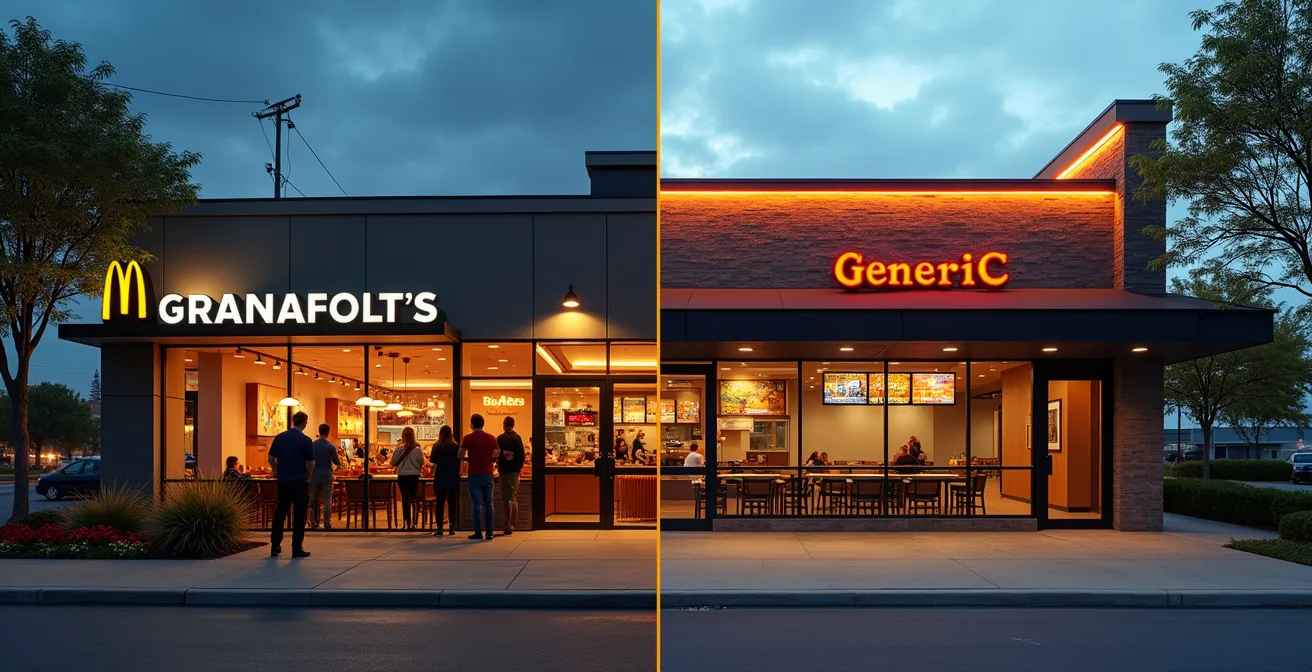
As this visual contrast suggests, the value is not just in the product but in the entire branded environment. Every time a customer chooses your franchise over the local generic spot, they are paying this “Logo Tax.” Protecting the integrity of that logo is paramount to protecting your revenue. It’s a shared responsibility, and a single non-compliant operator puts everyone’s share of that premium at risk.
The Opt-Out Risk: Why Skipping the National Promo Confuses Your Local Customers?
National advertising campaigns are a cornerstone of the franchise model. The franchisor invests millions from the collective marketing fund to build brand awareness and drive traffic to our doors with compelling offers. When a franchisee chooses to “opt-out” of a national promotion, they are not making an isolated business decision; they are fundamentally breaking the brand’s promise to the customer. This creates confusion, frustration, and a deep sense of mistrust that damages the entire network. A customer doesn’t distinguish between corporate and franchisee-owned stores; they just see one brand that failed to deliver on its advertised promise.
This inconsistency has a direct and measurable financial cost. Beyond the immediate loss of a sale, it erodes the foundation of customer loyalty. When a brand becomes unpredictable, customers are less likely to return. Maintaining a consistent experience is crucial, as data shows that brand consistency across all locations can increase customer retention by 20%. A 20% swing in retention is a massive lever for long-term profitability. By refusing to honor a national coupon or special, a single operator makes the entire brand appear unreliable, directly impacting the lifetime value of customers for all surrounding locations.
The sentiment is perfectly captured by marketing compliance experts who have studied this exact problem. As the team at Pica9 notes in their guide on the subject:
If a local store won’t honor an offer they saw in your commercials on TV, customers have a right to be annoyed.
– Pica9 Marketing Compliance Guide, The Ultimate Guide to Franchise Brand Marketing Compliance
This annoyance is a financial liability. It creates negative word-of-mouth and pushes customers toward competitors with more reliable offers. Each franchisee who participates in the national marketing fund has a right to expect that every other franchisee will uphold their end of the bargain. Opting out is not a cost-saving measure; it’s an act of brand equity sabotage that we all pay for.
The Font Police: Why Using Comic Sans on Your Window Sign Damages the Brand?
It may seem trivial—a handwritten sign, an unapproved font, or a slightly off-brand color scheme. Many franchisees dismiss these details as unimportant, focusing instead on food costs or labor schedules. This is a critical error in judgment. Visual identity is the language of a brand. It communicates professionalism, quality, and, most importantly, consistency. When a franchisee uses Comic Sans on a window sign, they are not just making a poor design choice; they are telling every passing customer that this location does not adhere to the same high standards as the others. They are creating a visual disconnect that screams “unofficial” and “unreliable.”
This visual sloppiness is a leading indicator of broader operational issues and has a quantifiable negative impact. It erodes the “Logo Tax” by cheapening the brand’s appearance. Research from IBISWorld provides stark evidence: franchises that adhered to global quality standards (which include visual branding) saw a 35% increase in revenue over five years, compared to just 18% for those with weaker systems. This gap highlights the immense ROI of meticulous quality control. Conversely, the failure to maintain these standards is costly. Studies have found that poor quality control, including brand presentation, can cost businesses between 15-20% of their sales revenue. That’s a massive financial penalty for something as seemingly small as using the wrong font.
Think of the brand’s visual guidelines not as restrictive rules, but as a shared asset. The specific font, the exact shade of blue, the layout of the menu—these are all carefully chosen elements designed to trigger a sense of familiarity and trust in the customer. When one franchisee disregards this visual toolkit, they introduce a foreign element that causes doubt. That doubt, however subconscious, translates into lost sales and diminished brand value for everyone. Being the “font police” isn’t about being petty; it’s about protecting the visual integrity that underpins our collective financial success.
The Multiple Boost: How Strong National Brand Equity Increases Your Exit Price?
For every franchisee, the ultimate financial goal is a profitable exit. The price you receive when you sell your business isn’t just based on your annual profit; it’s calculated using a valuation multiple. This multiple (e.g., 3x, 4x, 5x your earnings) is the most critical factor in your final sale price, and it is almost entirely determined by the perceived strength and stability of the national brand. A strong, consistent, and growing brand commands a higher multiple. A brand plagued by inconsistency and negative press is seen as riskier, and is therefore assigned a lower multiple. This is where your neighbor’s dirty store directly costs you hundreds of thousands of dollars.
Consider the real-world math. Business valuation is often determined by a multiple of Seller’s Discretionary Earnings (SDE) or EBITDA (Earnings Before Interest, Taxes, Depreciation, and Amortization). A buyer is not just purchasing your single store’s cash flow; they are buying into the entire franchise system’s future prospects. The stronger the system, the more they are willing to pay per dollar of earnings.
The following table illustrates how these multiples can vary. A small difference in the multiple, driven by brand perception, can result in a massive difference in your pocket at closing.
| Business Type | Valuation Method | Multiple Range | Typical Application |
|---|---|---|---|
| Small Owner-Operated | SDE Multiple | 2.74x – 3.36x | Franchises under $1M SDE |
| Mid-Size Professional | EBITDA Multiple | 3.82x – 4.17x | Franchises over $1M EBITDA |
| Revenue-Based | Revenue Multiple | 0.29x – 0.66x | Quick comparative analysis |

This is not a niche market; the value at stake is enormous. In fact, driven by the desire for established business models, the franchise resale market is projected to reach USD 16.27 Billion by 2033. To secure your premium share of that market, every franchisee must act as a steward of the brand’s reputation. Every positive customer experience, every compliant location, and every honored promotion contributes to a higher valuation multiple for the entire system. Every failure to do so is a direct attack on everyone’s exit strategy.
Where Does the Money Go? Demanding Transparency on Corporate Reinvestment
As franchisees, we are investors who pay significant fees—royalties, marketing contributions, tech fees—with the expectation of a return. That return comes in the form of support that strengthens our collective brand equity and, ultimately, our valuation multiple. Therefore, holding the franchisor accountable for how they reinvest our money is not an act of rebellion; it is an act of responsible financial oversight. If we are expected to maintain standards to protect the brand, we have a right to demand transparency and ensure our fees are being used effectively to build that brand’s value.
The Franchise Disclosure Document (FDD), particularly Items 6 and 11, outlines the fees we pay and the assistance the franchisor is obligated to provide. This document should be treated as a service-level agreement. It is our right and responsibility to track the value we receive. Are the IT systems reliable? Is the national marketing driving measurable traffic? Are the field consultants providing valuable, actionable advice? If the support is lacking, the fees we pay are not generating a positive ROI, and the brand’s value stagnates.
The connection between this support and our exit price is direct and undeniable. As valuation experts at K-Analytics explain, a higher multiple is not arbitrary:
If your franchise has an EBITDA of $250,000 and the earnings multiplier is 3x, the total valuation would be $750,000. However, if it is determined that the business should have a multiplier of 5x, the valuation increases to $1,250,000.
– K-Analytics, Top CFO’s Breakdown on Franchise Valuation
That $500,000 difference is largely determined by the brand’s strength, which is fueled by the franchisor’s reinvestment of our fees. To ensure our money is working for us, we should regularly review the FDD, benchmark our fees against other systems, and document all support requests to build a case for better service or fee negotiations. It’s our money, and it should be building our equity.
The ‘Refresh’ Mandate: How to Budget for Mandatory Remodels Every 7 Years?
The mandatory “refresh” or remodel, often required every 5-10 years, is frequently seen by franchisees as a burdensome and unwelcome capital expense. This perspective, however, misses the larger financial picture. A mandatory remodel is not a punishment; it is a crucial mechanism for preserving the asset value of the entire franchise system. A brand that looks dated, worn, and tired is a brand in decline. Declining brands are perceived as high-risk investments, which translates directly into lower valuation multiples for every single franchisee, regardless of how well-maintained their individual store may be.
Think of it as maintaining a portfolio of real estate. If one owner in a high-end condo building lets their unit fall into disrepair, it lowers the property value for everyone. The same principle applies to our franchise network. The refresh mandate ensures that the brand remains modern, relevant, and appealing to customers, thereby protecting the “Logo Tax” and the premium perception we all rely on. It is a forced savings plan for our collective brand equity. Delaying or fighting a remodel to save cash in the short term is a surefire way to diminish your much more valuable long-term exit price.
Planning for this exit is a long-term game. The process of selling a business is not instantaneous; on average, it takes 8-9 months to sell a strong franchise business. This means the condition and valuation of your business must be protected years in advance. Budgeting for the mandated remodel should be part of your long-range financial plan from day one. By treating it as a predictable and necessary investment in your future sale price, rather than an unexpected cost, you align your strategy with the goal of maximizing your final return. It is a capital expenditure that pays for itself through a higher valuation multiple at closing.
Key Takeaways
- Your franchise’s value is not isolated; it is directly tied to the collective performance and consistency of the entire brand network.
- Inconsistent branding and operations by one franchisee can directly reduce revenue potential by over 20% for neighboring locations by eroding customer trust.
- The ultimate goal, a high resale price, depends on a strong valuation multiple, which is primarily driven by the overall health and reputation of the national brand.
Are 6% Royalty Fees Justified by the Support You Receive from Headquarters?
The 6% royalty fee, a standard in many franchise systems, often feels like a simple tax on revenue. However, its true purpose is to fund the central nervous system that makes the entire brand a valuable asset. With over 200,000 quick-serve restaurants in the United States alone being franchises, the value is clearly in the system, not just the individual store. The royalty fee is our investment in the infrastructure—technology, training, supply chain, and field support—that creates the consistency necessary to justify a premium price and, more importantly, a high valuation multiple.
A royalty fee is justified only when the support it funds demonstrably contributes to the drivers of franchise value. These drivers are what potential buyers look for when determining what multiple to apply to your earnings. As the following analysis shows, key factors like growth rate, unit profitability, and brand differentiation are all heavily influenced by the quality of the franchisor’s support systems.
The table below breaks down the core components that build a brand’s value. The royalty fees you pay should directly fuel these engines of growth and profitability.
| Value Driver | Impact on Multiple | Key Metrics |
|---|---|---|
| Growth Rate | Higher unit growth = Higher multiple | Year-over-year unit expansion |
| Unit Profitability | Strong franchisee profits = Higher multiple | Average unit EBITDA |
| Organization Structure | Clear roles & systems = Higher multiple | Operational efficiency scores |
| Brand Differentiation | Unique positioning = Higher multiple | Market share & recognition |
| Revenue Streams | Multiple sources = Higher multiple | Royalties, supplies, fees diversity |
Therefore, the question is not whether a 6% fee is “fair,” but whether it is generating a return. Is the marketing support increasing our market share? Is the operational guidance improving our unit EBITDA? When we see a fellow franchisee failing to comply with standards, it is often a symptom of a larger problem: a potential failure in the support system that our royalties are supposed to fund. Holding the franchisor accountable for providing value in exchange for our fees is the other side of the coin to holding our peers accountable for upholding standards. Both are essential for protecting our investment.
Protecting your franchise’s value requires a proactive, investor-first mindset. It starts with understanding that you are part of a financial ecosystem where every member’s actions impact your net worth. By documenting issues, communicating strategically, and holding both your peers and your franchisor accountable, you shift from being a passive operator to an active guardian of your most valuable asset. The first step is to assess your current situation and build a case for brand integrity.