Delaying facility maintenance to preserve short-term cash is a false economy that puts your entire franchise investment at risk.
- Proactive maintenance isn’t a cost; it’s a high-leverage investment protecting you from catastrophic failures, as botched emergency DIY repairs can cost 3 to 5 times more than a professional fix.
- Building dedicated CapEx and contingency reserves from day one turns unpredictable disasters into manageable, budgeted events, transforming facility management from a liability into a core part of your financial strategy.
Recommendation: Shift from a reactive, cost-cutting mindset to a proactive asset management strategy to secure your long-term profitability and protect your capital.
As a franchisee, you live and die by your cash flow. Every dollar is scrutinized, and the temptation to delay a seemingly ‘non-essential’ $200 service call is immense. It feels like a smart, frugal decision—a way to keep cash in the bank for payroll or inventory. But I’ve seen this movie a hundred times, and it always ends the same way: with a frantic weekend call about a dead compressor and a crippling $5,000 emergency replacement bill that wipes out a month’s profit. The most expensive phrase in business isn’t “we need to spend money,” it’s “we’ll get to it later.”
The common wisdom says that every dollar spent on preventive maintenance saves five dollars in reactive repairs. While true, this advice often feels abstract when you’re staring at a tight budget. The real problem isn’t that owners are unwilling to spend money; it’s that maintenance is viewed as a disconnected, recurring cost center rather than a strategic financial tool. It’s seen as a chore, not an investment.
This guide changes that perspective. We’re going to move beyond the platitudes and reframe your entire approach to facility management. This is not about simply cleaning filters or fixing leaky faucets. It’s about implementing a robust financial framework that protects your assets, manages risk, and ensures the long-term profitability of your franchise. We will treat your equipment not as a collection of parts, but as a portfolio of valuable assets that require sophisticated management.
By adopting the mindset of a CFO, you will learn how to use tools like depreciation reserves, risk-weighted contingency funds, and total cost of ownership analysis to make informed, data-driven decisions. This is your playbook for turning unpredictable expenses into predictable, manageable operational lines, ensuring that a $200 service call never has the chance to become a $5,000 catastrophe.
This article provides a comprehensive financial framework for managing your franchise’s physical assets. The following sections break down the critical components you need to master, from daily operational discipline to long-term capital planning.
Summary: A Franchisee’s Guide to Preventing Costly Equipment Failures
- The Maintenance Wall: How to ensure Night Shift Actually Cleans the Filters?
- National Contracts vs Local Fixers: Who Responds Faster on a Sunday Night?
- Warranty Voided: The 3 DIY Fixes That Kill Your Manufacturer’s Coverage
- The “Oh No” Fund: How Much Cash Should You Reserve for Equipment Failure?
- The 50% Rule: When to Stop Fixing That Old Oven and Buy a New One?
- The “Hidden” Walls: Why You Need a 15% Contingency Fund for Renovations
- Depreciation is Real Cash: Why You Need a CapEx Reserve Fund from Year 1?
- Managing Leasehold Improvements: How to Avoid Construction Delays That Cost $1,000 a Day?
The Maintenance Wall: How to ensure Night Shift Actually Cleans the Filters?
The single biggest point of failure in any maintenance program isn’t the equipment; it’s the gap in accountability between shifts. The night crew is often leaner, with less supervision, making it the perfect environment for “pencil-whipping” checklists. A dirty filter or an un-greased bearing seems minor at 2 a.m., but it’s the root cause of countless daytime breakdowns. The solution isn’t more nagging; it’s building a verifiable system of proof that makes compliance easier than non-compliance.
This means moving away from paper checklists and toward digital, time-stamped verification. When a task requires a photo or a digital sign-off integrated into the machine’s start-up procedure, it removes ambiguity. The goal is to create a culture where maintenance isn’t a forgotten task, but a non-negotiable part of the operational rhythm. The visual below represents this systematic approach, where documentation is an integral part of the environment.
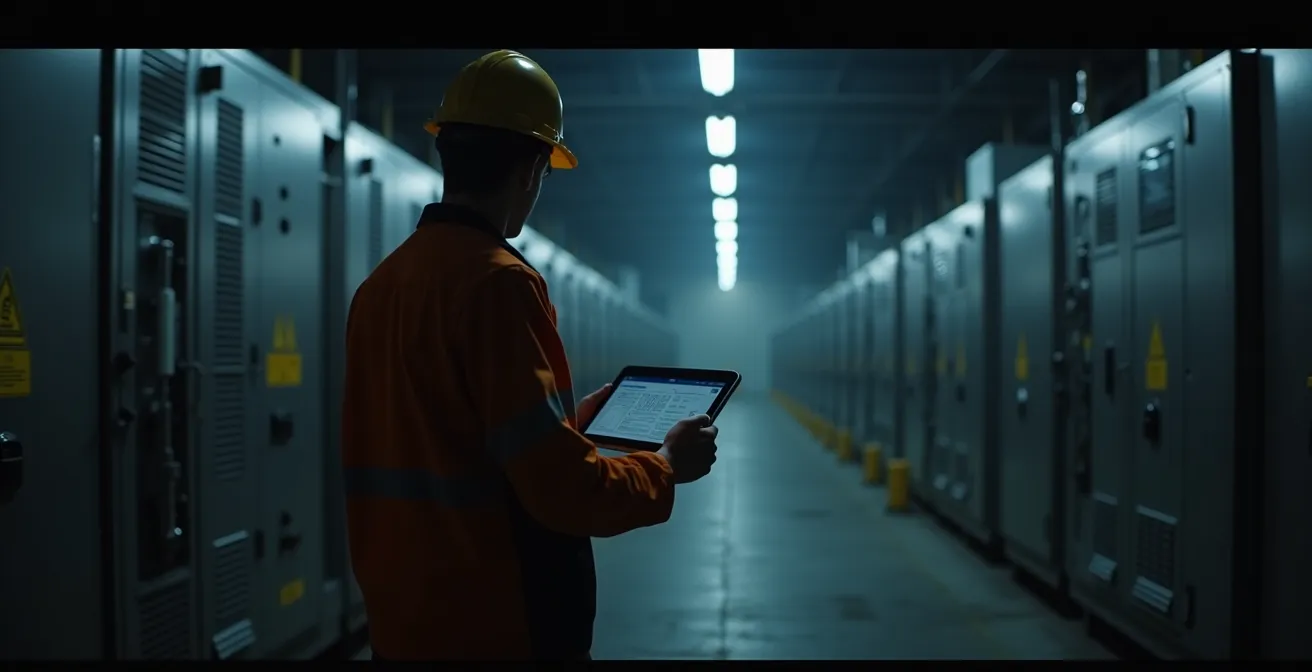
As the image suggests, the process should be built into the workflow itself, illuminated by the operational environment. Publicly tracking compliance rates by shift introduces a healthy level of competition and team ownership. When combined with small, team-based incentives for hitting compliance targets, you shift the dynamic from a top-down mandate to a bottom-up habit. This isn’t about distrust; it’s about building a resilient system that functions flawlessly, regardless of who is on the clock.
Action Plan: Night Shift Maintenance Accountability
- Implement time-stamped photo documentation requirements for completed maintenance tasks during each shift.
- Create a dedicated digital channel (e.g., in Slack or Teams) for maintenance proof uploads with automatic timestamp verification.
- Integrate filter checks into machine start-up procedures with mandatory physical sign-off tags or digital confirmation.
- Track compliance rates by shift and display them publicly in a common area to foster team accountability and transparency.
- Link small, team-based incentives (like gift cards or a team meal) to achieving 95%+ monthly compliance targets.
National Contracts vs Local Fixers: Who Responds Faster on a Sunday Night?
When your main freezer dies on a Sunday night, the only thing that matters is getting it fixed—fast. The debate between a national service contract and a trusted local technician is a critical one for any franchisee. It’s a classic trade-off between guaranteed response and specialized expertise. A national provider offers a Service Level Agreement (SLA), often guaranteeing a technician on-site within 2-4 hours, 24/7. This provides peace of mind, but that technician might be a generalist seeing your specific oven model for the first time.
Conversely, the local fixer you’ve used for years knows your equipment inside and out. They are more likely to have the right part on their truck and achieve a first-time fix. However, their availability is not guaranteed. They might be at a family dinner or on another job, pushing your response time to 4-6 hours or even the next morning. The cost of that downtime, measured in lost revenue and spoiled inventory, can be devastating. As an industry analysis points out, downtime costs can range from thousands to hundreds of thousands of dollars per hour, making speed and effectiveness equally critical.
The decision requires a clear-eyed assessment of your risks and priorities. Is your equipment standard enough for a generalist, or is it a specialized unit that requires deep expertise? The following table breaks down the key factors to help you make a calculated decision, not a panicked one.
| Factor | National Contract | Local Service Provider |
|---|---|---|
| Response Time | 2-4 hours guaranteed | Variable, often 4-6 hours |
| Parts Availability | Extensive inventory network | Limited but specialized stock |
| First-Time Fix Rate | 65-70% | 80-85% for known equipment |
| Sunday/Holiday Surcharge | 150-200% standard rate | 125-150% standard rate |
| Equipment Familiarity | General knowledge | Deep local expertise |
Ultimately, a hybrid approach may be best: a national contract for critical, 24/7 coverage on standard systems like HVAC and refrigeration, and a relationship with a local expert for specialized cooking or production equipment during business hours. This balances guaranteed response with deep expertise, providing a layered defense against downtime.
Warranty Voided: The 3 DIY Fixes That Kill Your Manufacturer’s Coverage
The temptation to perform a “simple” DIY fix is powerful for a frugal franchisee. Why pay a technician $150 for something you saw fixed in a 5-minute YouTube video? The primary fear holding you back is often the manufacturer’s warranty. The sticker on the back of the machine explicitly warns that opening the unit will void all coverage. However, the reality of warranty law is more nuanced than manufacturers would have you believe. In fact, as a consumer protection agency notes:
The FTC says the choice is yours, and companies that void your warranty for choosing an independent shop or to fix it yourself may be breaking the law.
– Federal Trade Commission, FTC Consumer Alert on Warranty Restrictions
The real risk isn’t voiding the warranty by opening the case; it’s the damage caused by an improper repair. A botched DIY attempt is what truly kills your coverage and your budget. When a certified technician has to fix your mistake before they can even start on the original problem, the costs multiply. The financial leverage works in reverse: saving $150 on a service call can easily lead to a $750 bill. Here are the three DIY “fixes” that consistently lead to disaster:
- Using unauthorized parts: That generic replacement heating element you found online for a third of the price may not have the same wattage or safety ratings. It can lead to poor performance, electrical shorts, or even a fire, causing damage the manufacturer will refuse to cover.
- Bypassing safety sensors: When a machine keeps tripping a safety switch, it’s a symptom, not the problem. Taping down a switch or bypassing a thermal cutoff to keep the machine running is like silencing a fire alarm because you don’t like the noise. It invites catastrophic failure of the core components it was designed to protect.
- Incorrect electrical work: Swapping a component might seem like plug-and-play, but mixing up wires, using the wrong gauge, or failing to properly ground a unit can fry a central control board—turning a $100 part replacement into a $1,500 system-wide failure. This kind of cascading damage is rarely covered by any warranty.
The “Oh No” Fund: How Much Cash Should You Reserve for Equipment Failure?
Every franchisee knows they need an emergency fund, but “as much as possible” is not a strategy. A properly structured “Oh No” fund, or equipment reserve, is a calculated financial tool, not just a pile of cash. Without it, a single major failure forces you to make terrible decisions: drain operating cash, take on high-interest debt, or limp along with broken equipment that kills revenue. The key is to move from guessing to calculating, using industry benchmarks as a starting point. As a rule of thumb, experts suggest that facilities should budget approximately 2% to 5% of total RAV (Replacement Asset Value) for annual maintenance.
For example, if your franchise has $250,000 worth of equipment, your annual maintenance and repair budget should be between $5,000 and $12,500. This is your Operating Expense (OpEx) reserve, funded monthly to cover routine service and minor repairs. But this is only half the picture. You also need a Capital Expense (CapEx) reserve for major replacements. The visual below represents the careful calculation needed for this financial planning.

A more sophisticated approach goes beyond a flat percentage and uses a risk-weighted model. This method acknowledges that not all equipment is created equal. A failure of your primary oven during the dinner rush is far more critical than a prep table light burning out. By assigning a criticality multiplier and factoring in the asset’s age, you create a much more accurate and defensible reserve fund. This ensures you have the right amount of cash set aside for the most probable and most damaging failure scenarios.
Your Action Plan: Building a Risk-Weighted Reserve
- Calculate base reserve: Multiply each asset’s Replacement Cost by an Age Factor (e.g., 0.1 for new, 0.3 for mid-life, 0.5 for end-of-life).
- Apply criticality multiplier: Multiply the base reserve by a factor based on the asset’s importance (e.g., Essential x1.5, Important x1.2, Standard x1.0).
- Add downtime costs: Estimate the daily revenue loss from the asset’s failure and multiply it by the expected number of repair days. Add this to the reserve.
- Create a dual structure: Formally separate your OpEx Maintenance Reserve (funded monthly for repairs) from your CapEx Replacement Reserve (funded annually based on depreciation).
- Review quarterly: Adjust your reserve amounts every quarter based on your actual maintenance history, repair costs, and updated equipment condition assessments.
The 50% Rule: When to Stop Fixing That Old Oven and Buy a New One?
There’s a point of diminishing returns for every piece of equipment. Pouring money into an aging asset that constantly breaks down is one of the most common financial traps for a franchisee. It’s driven by a “sunk cost” fallacy—the feeling that you’ve already invested so much in repairs, one more can’t hurt. A simple but effective guideline is the 50% Rule: if a single repair costs more than 50% of the price of a new, comparable unit, you should seriously consider replacement. This prevents you from throwing good money after bad on an asset that is clearly at the end of its useful life.
However, the 50% rule is a heuristic, not an ironclad law. A truly strategic decision requires a broader look at the Total Cost of Ownership (TCO). An old oven might be cheap to repair this one time, but what about its hidden costs? It might be 30% less energy-efficient than a new model, adding hundreds of dollars to your utility bill each year. Its declining reliability could be creating “operational drag,” slowing down your kitchen staff and affecting service quality. As one analysis on machinery costs notes, a significant repair can cost more than the machine is worth, and a full replacement often makes more sense when all factors are considered.
To make the right call, you need to move beyond just the immediate repair bill. A decision matrix helps you evaluate the asset from multiple angles, forcing a logical, ROI-focused conclusion instead of an emotional one.
| Decision Factor | Keep & Repair | Replace |
|---|---|---|
| Current Repair Cost vs Asset Value | Less than 30% | More than 50% |
| Annual Maintenance Trend | Stable or decreasing | Increasing 20%+ yearly |
| Energy Efficiency Gap | Within 15% of new models | 30%+ less efficient |
| Parts Availability | Readily available | Discontinued/scarce |
| Compliance Status | Meets current regulations | Non-compliant by 2026 |
If your aging asset is ticking multiple boxes in the “Replace” column, the financial case is clear. The short-term pain of a capital outlay for a new unit is far preferable to the long-term, bleeding cost of keeping a zombie asset alive.
The “Hidden” Walls: Why You Need a 15% Contingency Fund for Renovations
A renovation or expansion project is exciting—it signals growth. But it’s also one of the riskiest financial endeavors for a franchisee. The budget you approve is rarely the final price you pay. Behind every wall and under every floorboard lie potential surprises that can derail your timeline and decimate your budget. This is why a 15% contingency fund is not a “nice-to-have”; it’s a non-negotiable requirement for any construction project. It’s the buffer that stands between you and a half-finished, cash-strapped disaster.
This fund is designed to absorb the inevitable shocks that come with construction. You might discover outdated wiring that needs to be brought up to code, hidden water damage, or even structural issues that were invisible during the initial inspection. Without a contingency, these discoveries trigger a crisis. You’re forced to cut corners on finishes, delay the opening, or seek emergency funding. For example, a common surprise like an unexpected HVAC failure can be costly, with data showing that replacing a typical air conditioning unit for a small business can run as high as $2,000 or more.
A sophisticated franchisee doesn’t just set aside a lump 15%. They structure it using a tiered strategy to account for different types of risk:
- 5% for “Known Unknowns”: These are the things you suspect you might find. You know you’ll be opening a wall, so you budget for potential plumbing or electrical surprises within that wall.
- 7% for “Unknown Unknowns”: This is for genuine, out-of-the-blue disasters. Think asbestos abatement, a cracked foundation, or a major issue flagged by a city inspector that no one could have predicted.
- 3% for Scope Creep: This is the most predictable “surprise” of all. It covers the “while we’re at it” changes you or the franchisor decide to make mid-project. Budgeting for it upfront prevents it from blowing up your core project finances.
Furthermore, you should contractually incentivize your builder to be frugal with this fund. A clause that shares a percentage (e.g., 25%) of any unused contingency as a bonus for on-budget delivery aligns their interests with yours. It encourages them to solve problems efficiently rather than seeing the contingency as a slush fund.
Depreciation is Real Cash: Why You Need a CapEx Reserve Fund from Year 1?
For many new franchisees, “depreciation” is an abstract accounting term—a non-cash expense that your accountant uses to lower your tax bill. This is a dangerously incomplete understanding. Depreciation is the most predictable, yet most ignored, cash flow in your business. It represents the very real, physical decline in the value of your assets. The IRS itself provides a clear definition.
The IRS describes depreciation as ‘an annual income tax deduction that allows you to recover the cost or other basis of certain property over the time you use the property’
– Internal Revenue Service, IRS guidance on equipment depreciation
The key phrase is “recover the cost.” The tax deduction is the mechanism, but the strategic purpose is to allow you to systematically set aside the funds needed to eventually replace that asset. If you buy a $50,000 oven with a 10-year lifespan, you are effectively “spending” $5,000 of that oven’s value each year. If you aren’t physically moving that $5,000 in cash from your operating account to a separate CapEx (Capital Expenditure) reserve account, you are not recovering the cost. You are simply letting the asset waste away while enjoying a temporary tax benefit.
This is how businesses with great paper profits suddenly find themselves with no cash when a critical piece of equipment dies in year eight. They never treated depreciation as real money. From day one, your financial process should be: if your P&L statement shows a $1,000 depreciation expense for the month, you should be making a $1,000 cash transfer to your CapEx reserve fund. As one financial guide illustrates, your balance sheet might show equipment at $50,000 and accumulated depreciation at $30,000, meaning its book value is only $20,000. Your CapEx fund should ideally have that $30,000 in cash, ready for the inevitable replacement.
This discipline turns a future capital crisis into a predictable, fully-funded event. It is the single most powerful strategy for ensuring the long-term financial health and stability of your franchise. It’s the difference between managing your business’s lifecycle and being a victim of it.
Key Takeaways
- Shift your mindset from reactive cost-cutting to ROI-based maintenance. Every dollar spent on prevention leverages against a much larger, catastrophic failure.
- Systematize everything. Create verifiable, digital systems for daily tasks like filter cleaning and build structured, data-driven financial reserves for repairs and replacements.
- Treat depreciation as a real cash expense. From day one, match your monthly depreciation deduction with a physical cash transfer to a dedicated CapEx reserve fund.
Managing Leasehold Improvements: How to Avoid Construction Delays That Cost $1,000 a Day?
Before you can even worry about maintaining equipment, you have to build out your space. For a franchisee, managing leasehold improvements is a high-stakes game where every day of delay is a day of lost revenue—potentially $1,000 or more. The biggest source of these delays is often not the contractor, but the slow, bureaucratic approval process with the landlord. Your grand opening can be held hostage for weeks waiting for a single signature on a plumbing schematic or an electrical plan.
You cannot afford to be passive in this process. The power to control your timeline lies in the negotiations you conduct before you sign the lease. This is your moment of maximum leverage. Once the ink is dry, you are largely at the mercy of the landlord’s schedule. A savvy franchisee front-loads the risk management by building timeline protections and financial penalties directly into the lease agreement itself. This isn’t about being adversarial; it’s about creating a clear, mutually understood set of expectations and consequences that keep the project moving.
For instance, your lease should stipulate firm deadlines for landlord reviews (e.g., “10 business days for initial plan review”). It should also include a clause for “Delayed Opening Credits,” where for every day of delay caused by the landlord past an agreed-upon date, you receive 1.5 days of free rent. This provides a powerful financial incentive for them to prioritize your project. By identifying long-lead items like custom millwork or specialized HVAC units and getting pre-approval *before* signing, you can order them months in advance and eliminate them as a source of delay. Your job is to anticipate the bottlenecks and legally engineer a solution before they happen.
Stop treating your facility as a liability. Start implementing this financial framework today to turn it into a predictable, profitable asset that secures your investment for years to come.