
The solution to food waste isn’t better spreadsheets; it’s a fully automated logistics system that transforms inventory from a manual chore into a predictive, self-optimizing asset.
- AI-driven forecasting and direct POS-to-supplier integration eliminate guesswork and administrative overhead.
- Digital tracking for FIFO and real-time variance analysis pinpoint losses from spoilage and theft before they impact your bottom line.
Recommendation: Shift focus from physically counting stock to analyzing the data flowing through your supply chain. That is where your profits are won or lost.
For any restaurant or retail owner, the sight of food being thrown away is the sight of profits vanishing into the trash bin. The conventional wisdom has long been to tighten up manual controls: more frequent stock counts, meticulous clipboard checks, and endless spreadsheet reconciliations. This approach, however, treats the symptom, not the disease. It assumes that with enough human effort, waste can be minimized. But what if this entire paradigm is flawed?
The core problem isn’t a lack of diligence; it’s a lack of data-driven intelligence. Manual inventory management is inherently reactive, imprecise, and incredibly time-consuming. It’s a system built on guesswork and historical averages, unfit for the dynamic reality of fluctuating demand, supply chain disruptions, and razor-thin margins. The real culprit behind that 20% waste figure isn’t a careless employee; it’s an obsolete process.
This article reframes the challenge entirely. We will not discuss how to count boxes more efficiently. Instead, we will build the case for a new approach: creating a cohesive, automated logistics “nervous system” for your business. This is about connecting your point of sale, your inventory, and your suppliers into a single, intelligent entity. The secret to slashing food waste lies not in working harder, but in implementing a smarter, predictive system that makes waste a solvable data problem, not an inevitable cost.
We will explore how this integrated system works, from AI-powered ordering and automated supplier communication to digital product tagging and data-driven theft prevention. Each component is a step toward transforming your supply chain from a cost center into a strategic advantage, freeing up capital, time, and protecting your profits from the bin.
Summary: From Waste Management to Profit Optimization With Smart Logistics
- AI Forecasting: How to Order Exactly What You Need for Next Tuesday’s Lunch Rush?
- The “One-Click” Order: Connecting Your POS Directly to Your Broadliner’s System
- First-In, First-Out: How Digital Tagging Prevents Expiration Losses?
- The Variance Report: How to Spot Internal Theft Through Logistics Data?
- Just-in-Time Delivery: Reducing Storage Needs for Small Footprint Locations
- Par Levels vs Dynamic Ordering: Which Method Saves You 5 Hours of Admin per Week?
- How to Protect Your Margins When Ingredient Prices Spike by 20% Overnight?
- How to Slash Inventory Holding Costs by 15% With Predictive Ordering Systems?
AI Forecasting: How to Order Exactly What You Need for Next Tuesday’s Lunch Rush?
Predicting future sales is the foundational challenge of inventory management. Traditional methods rely on historical averages, often failing to account for the multitude of variables that impact a single day’s business: weather, local events, marketing promotions, or even a sudden shift in consumer trends. This guesswork is a primary driver of waste through over-ordering or lost sales from under-ordering. AI forecasting replaces these crude estimates with a sophisticated, multi-layered analysis, creating a true predictive ordering engine.
Modern AI systems don’t just look at last Tuesday’s sales. They ingest and analyze data from dozens of sources in real time. By tracking sales patterns, seasonality, and external factors, these tools forecast demand with a level of accuracy that is impossible to achieve manually. The result is a highly granular order recommendation, optimized not just for the day, but for the specific service period, like a Tuesday lunch rush. This move from reactive to predictive procurement is a game-changer. For example, some hospitality companies now use AI-driven technologies that integrate with kitchen operations to provide insights, helping staff adjust portion sizes and optimize inventory in real time, a method detailed in a recent study on AI-powered waste tracking.
The impact is significant and immediate. Take the case of Chipotle Mexican Grill, which implemented a smart system to gain deeper insights into its ingredient usage patterns. This data-first approach allowed them to optimize ordering and reduce waste substantially. The implementation of their system resulted in an impressive 35% reduction in food waste within six months. This demonstrates that by leveraging AI, ordering becomes a precise science, directly reducing the volume of perishable goods at risk of spoilage.
The “One-Click” Order: Connecting Your POS Directly to Your Broadliner’s System
Once you have an accurate forecast, the next bottleneck is the ordering process itself. Manual ordering involves compiling lists, logging into multiple supplier portals, and creating purchase orders—a process ripe for human error and consuming hours of administrative time. The goal of a modern logistics system is to achieve “zero-admin ordering,” where the flow of data from sale to purchase order is entirely automated. This is accomplished by creating a direct digital bridge between your Point of Sale (POS) system and your suppliers’ (or broadliner’s) ordering platforms.
This integration creates a real-time feedback loop. Every time an item is sold, the POS decrements the inventory count. The system constantly cross-references these live inventory levels with the AI-generated sales forecast and pre-set par levels. When stock for a particular ingredient drops below the dynamically calculated threshold, the system can automatically generate and even send a purchase order to the appropriate supplier without any human intervention. This ensures that you are replenishing exactly what you need, precisely when you need it.
This concept is already in practice with platforms like Lavu, which integrates real-time inventory management directly with its POS. Every sale automatically updates inventory levels, creating a smarter way to manage stock and trigger orders. This seamless data flow is the connective tissue of the logistics nervous system, eliminating the administrative friction that leads to costly ordering mistakes and delays.
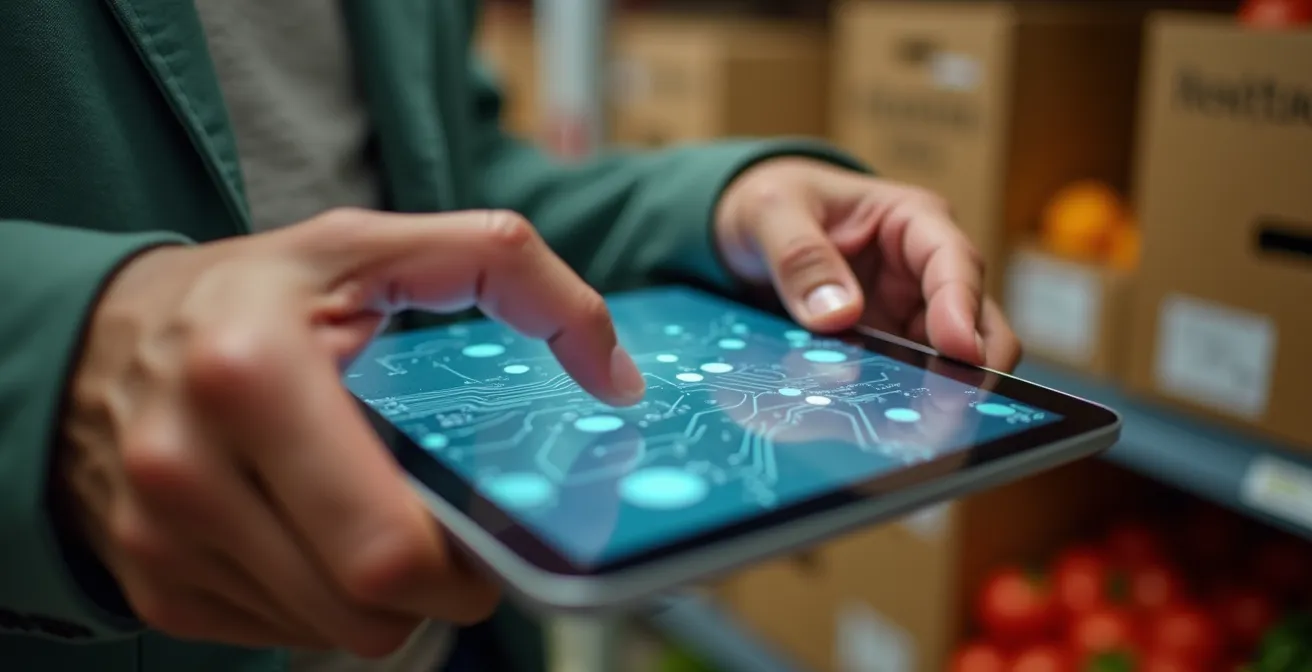
As illustrated, the interaction is no longer about manual data entry but about supervising an automated workflow. The manager’s role shifts from a clerk to a strategist, overseeing the system’s performance rather than executing its tedious tasks. This frees up valuable time to focus on service, staff training, and other high-value activities that directly impact the customer experience.
First-In, First-Out: How Digital Tagging Prevents Expiration Losses?
First-In, First-Out (FIFO) is a fundamental principle of inventory management, yet its manual execution is notoriously unreliable. Staff must physically check dates, rotate stock, and ensure older products are used first. In a busy kitchen or stockroom, this process often breaks down, leading directly to spoilage and waste. Digital tagging and tracking automate FIFO, bringing precision and accountability to stock rotation and transforming it from a hopeful policy into a verifiable process.
Instead of relying on handwritten dates on a box, modern systems use barcodes, QR codes, or even RFID tags. When new inventory arrives, each case or item is scanned, capturing its delivery date and expiration date in the central system. This creates a digital record for every single item in your inventory. The system now knows exactly how old each unit of product is and where it is located.
When a staff member needs an ingredient, the system can guide them. A handheld scanner or tablet can direct them to the precise shelf location of the oldest stock, ensuring it gets used first. Furthermore, the system can generate automated alerts for items approaching their expiration date. This allows managers to proactively run promotions or create specials to move that product before it becomes waste. This transforms inventory from a collection of perishable goods into a data-first inventory, where every item is tracked and its lifecycle managed digitally.
This level of granular control is impossible with manual methods. It eliminates the “out of sight, out of mind” problem where older products get pushed to the back of the shelf and forgotten. By digitizing FIFO, you enforce best practices automatically, drastically reducing losses from expired products and ensuring optimal product quality for your customers.
The Variance Report: How to Spot Internal Theft Through Logistics Data?
Inventory variance—the difference between what your records say you should have and what you physically have—is a major source of profit loss. While some variance is due to normal spoilage or portioning errors, a significant portion can often be attributed to internal theft or unauthorized waste. A manual inventory system makes it nearly impossible to distinguish between these causes. An automated logistics system, however, generates a powerful “variance signal,” using data to pinpoint the exact source of the leak.
Because the system tracks every sale and every unit of inventory digitally, it can calculate the theoretical usage of each ingredient with high precision. At the end of a shift, day, or week, the system compares this theoretical usage to the actual on-hand inventory. The resulting variance report is no longer a simple, aggregated number; it’s a detailed breakdown by item, shift, and even employee. According to EPA data, the average restaurant produces 100,000 pounds of waste per year, and identifying the source of this waste is the first step to reducing it.
This granular data allows you to identify patterns that are invisible in a manual system. Is there a consistent, small overage on ground beef across all shifts? That’s likely a staff training issue related to over-portioning. Is an entire bottle of premium liquor disappearing only during a specific employee’s shift? That’s a strong indicator of theft. The data provides objective evidence, moving you from suspicion to actionable insight.
This table illustrates how different data patterns can point to specific operational issues, allowing for targeted interventions rather than broad, ineffective policy changes.
| Variance Type | Pattern | Likely Cause | Action Required |
|---|---|---|---|
| Consistent 5% on ground beef | Daily, across all shifts | Over-portioning (training issue) | Staff retraining on portions |
| 100% on premium liquor | Specific shifts only | Potential theft | Investigation and monitoring |
| Variable on produce | Seasonal fluctuation | Quality variation | Supplier discussion |
| Spike on weekends | High-volume periods | Rush preparation errors | Process optimization |
Just-in-Time Delivery: Reducing Storage Needs for Small Footprint Locations
Excess inventory doesn’t just tie up capital; it consumes physical space. For businesses in high-rent urban areas or with small-footprint locations, storage is a premium commodity. The traditional “just-in-case” model of holding large amounts of safety stock is both expensive and a major contributor to food waste. The Just-in-Time (JIT) inventory model, powered by an automated logistics system, flips this paradigm by coordinating deliveries so that ingredients arrive only as they are needed.
JIT is only possible with the kind of accurate, real-time data that an integrated system provides. The AI forecasting engine predicts demand, and the automated ordering system communicates these needs to suppliers for smaller, more frequent deliveries. Instead of receiving a week’s worth of produce that sits in a cooler risking spoilage, you might receive deliveries every two or three days, perfectly matched to your short-term sales forecast. This approach minimizes the amount of perishable goods held on-site at any given time.

The benefits are twofold. First, it dramatically reduces the risk of spoilage and obsolescence, directly cutting food waste. As the JIT methodology prioritizes efficiency by matching supplier deliveries closely with customer needs, it shortens the storage duration for perishable goods. Second, it significantly reduces the need for large storage areas, freeing up valuable square footage that can be repurposed for revenue-generating activities, like adding more seating. For a small cafe or a ghost kitchen, this can be the difference between profitability and failure.
This lean approach requires a high degree of trust and coordination with reliable suppliers, a relationship that is fostered and managed by the system’s data-sharing capabilities. The entire supply chain becomes more efficient, agile, and resilient, diminishing waste at every step.
Par Levels vs Dynamic Ordering: Which Method Saves You 5 Hours of Admin per Week?
The method used to trigger reorders is a critical control point for both efficiency and waste. The two primary approaches are static par levels and dynamic ordering. Static par levels involve setting a fixed minimum quantity for each item. When stock drops below this “par,” you reorder to a fixed maximum. While simple, this method is rigid and unresponsive to changes in demand, often leading to overstock or stockouts.
Dynamic ordering, in contrast, is the output of the AI-driven system we’ve been discussing. It doesn’t rely on a single fixed number. Instead, it continuously calculates optimal order points based on real-time sales velocity, lead times, and demand forecasts. If the system predicts a busy weekend for a specific dish, it will dynamically increase the par level for its ingredients and trigger a larger order. Conversely, during a slow period, it will lower the par to prevent overstocking. This adaptability is what saves both money and time.
The efficiency gains are significant. A dynamic system eliminates the need for managers to manually review sales data and adjust par levels, a task that can consume hours each week. The system does the analysis automatically, freeing up leadership to focus on strategic tasks. The following table, based on industry analysis, highlights the difference in outcomes.
This comparison, based on data from a restaurant inventory management analysis, clearly shows that while a static approach has its place for non-perishables, a dynamic system offers superior efficiency and waste reduction for the most critical and volatile parts of your inventory.
| Method | Best For | Time Saved Weekly | Waste Reduction |
|---|---|---|---|
| Static Par Levels | Non-perishables, stable items (salt, flour) | 2-3 hours | 10-15% |
| Dynamic Ordering | Perishables, volatile items (fresh fish, produce) | 5-7 hours | 25-30% |
| Hybrid Approach | Mixed inventory types | 4-5 hours | 20-25% |
How to Protect Your Margins When Ingredient Prices Spike by 20% Overnight?
Food costs are volatile. A sudden frost, a geopolitical event, or a shift in fuel prices can cause the cost of a key ingredient to spike by 20% or more overnight, directly eroding your margins. A business running on a manual, reactive inventory system has very little defense against these shocks. An automated, data-driven logistics system, however, provides several layers of protection to insulate your profitability from market volatility.
First, the system’s efficiency directly combats rising costs. By minimizing waste through accurate forecasting and automated FIFO, you are already using every dollar of your food spend more effectively. When an ingredient’s price increases, wasting less of it becomes even more critical. The system ensures you are not throwing away overpriced inventory. Second, the detailed data on ingredient usage allows for strategic menu engineering. The system can immediately show you the impact of a price spike on the cost-of-goods-sold (COGS) for each menu item. This allows you to quickly identify which dishes are now unprofitable and make data-informed decisions: Can you temporarily remove the item, substitute a more stable ingredient, or adjust the price?
Most importantly, the investment in this technology pays for itself many times over. The efficiency gains and waste reduction create a significant financial buffer. In fact, comprehensive research shows that companies save an average of $14 for every $1 invested in food waste reduction technologies. This remarkable ROI isn’t just a cost-saving measure; it’s a strategic investment in the financial resilience of your business, providing the agility needed to absorb and respond to unpredictable cost fluctuations without sacrificing your bottom line.
Key Takeaways
- Automation is not about replacing staff; it’s about empowering them with better data to eliminate guesswork and manual tasks.
- An integrated system (POS, inventory, suppliers) creates a “logistics nervous system” that is far more efficient than siloed manual processes.
- The biggest gains come from shifting from a reactive “just-in-case” inventory model to a predictive, data-driven “just-in-time” approach.
How to Slash Inventory Holding Costs by 15% With Predictive Ordering Systems?
Every item sitting on your shelves represents tied-up capital. These are your inventory holding costs—the sum of the capital cost, storage space, insurance, and the risk of spoilage or obsolescence. A predictive ordering system attacks these costs from every angle, aiming to keep your inventory as lean and efficient as possible. The global scale of the problem is staggering; according to the UNEP’s 2024 Food Waste Index Report, 1.05 billion tonnes are wasted annually, with a huge portion coming from the service industry’s supply chains.
A predictive system slashes holding costs primarily by reducing the total volume of inventory you need to carry. Through Just-in-Time deliveries and hyper-accurate forecasting, it minimizes the “safety stock” that inflates your inventory levels and ties up cash. Less inventory means less capital is sitting idle in the stockroom, freeing it up for investment in growth, marketing, or other areas of the business.

Furthermore, the system optimizes the entire lifecycle of your inventory to minimize loss. By integrating with IoT sensors to monitor temperature and humidity, it helps extend the shelf life of what you do have. By connecting with platforms like Too Good To Go, it can even help monetize predicted surplus before it becomes waste. This holistic approach, from procurement to disposal, ensures that you are extracting the maximum value from every dollar spent on ingredients. The result is a direct, measurable reduction in holding costs, often by 15% or more, contributing significantly to your overall profitability.
Action Plan: Audit Your Holding Costs with Automation
- Implement automated reports for daily waste tracking and cost analysis to establish a baseline.
- Set up automatic reordering when stock dips below AI-optimized levels to prevent overstocking.
- Integrate IoT sensors to track temperature and humidity for perishable goods, ensuring optimal shelf life.
- Use AI to analyze past sales, seasonal trends, and supplier timelines to refine ordering frequency.
- Connect with platforms like Too Good To Go or local food banks to create a process for monetizing or donating predicted surplus.
Ultimately, transforming your supply chain is a strategic imperative. The shift from manual, reactive processes to an automated, predictive logistics system is the single most impactful step you can take to stop wasting food and start optimizing profits. Begin today by auditing your current processes and identifying the first component—whether it’s forecasting, ordering, or tracking—that you can automate to build a more resilient and profitable business.