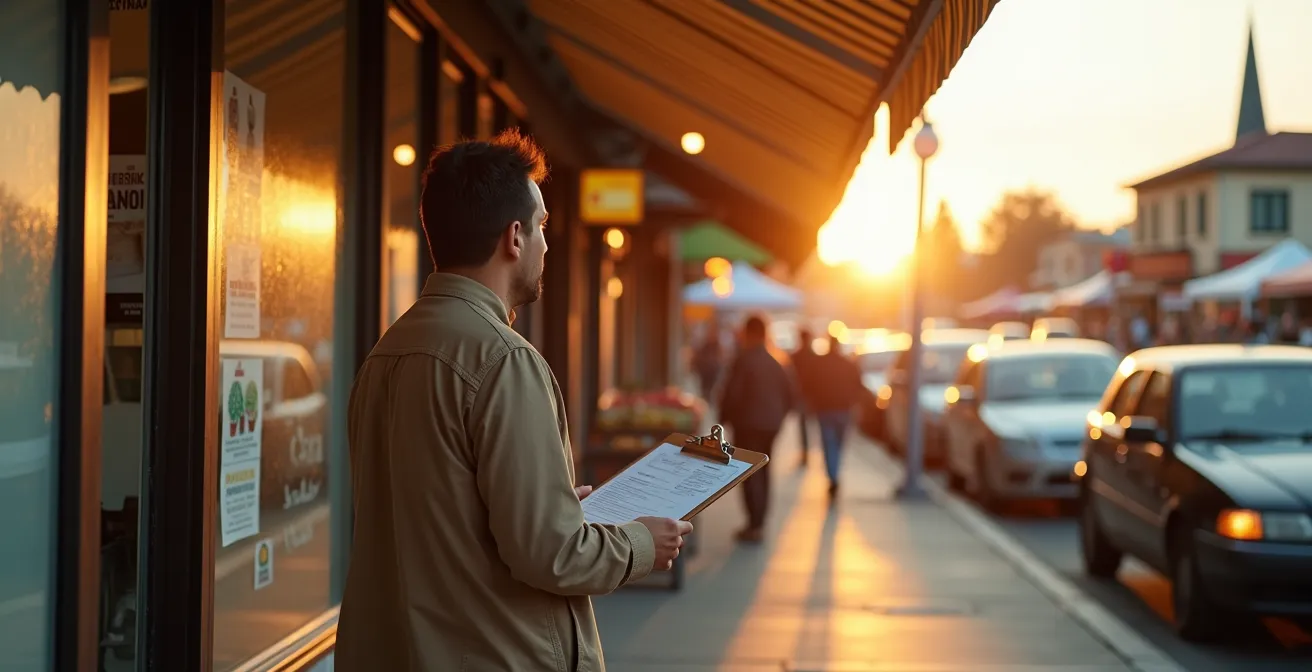
Most franchisees think local success comes from following the brand book closely. The reality is the opposite: success hinges on strategic, intelligent deviation from corporate standards to become an irreplaceable part of the local community.
- National bestsellers often fail because they don’t align with the unwritten rules and rituals of the neighborhood’s “firmware.”
- Genuine community trust is built through targeted, high-ROI local sponsorships, not generic involvement.
Recommendation: Shift your mindset from being a brand outpost to becoming a “Community Keystone”—the essential local hub that happens to be part of a franchise.
As a franchisee, you live with a fundamental tension: the push for global brand consistency versus the pull of local customer reality. You’ve been handed a proven playbook, a multi-million dollar brand identity, and a list of best-selling products. Yet, on the ground, in your specific neighborhood, something feels off. The national promotions fall flat, the corporate-approved language feels stiff, and sales don’t reflect the brand’s nationwide success. It’s a common frustration that leads many to double down on the corporate strategy, assuming the local market is simply “difficult.”
The standard advice is a chorus of familiar refrains: “do local marketing,” “understand your customers,” “get involved.” While not wrong, this advice is dangerously superficial. It fails to address the core conflict between rigid brand standards and the fluid, nuanced expectations of a tight-knit community. It doesn’t tell you *how* to navigate the clash between local zoning laws and brand architecture, or *when* to risk a “rogue” social media post that resonates locally but may violate national guidelines.
But what if the key to unlocking your local market isn’t about better adherence to the brand book, but about mastering the art of strategic non-compliance? This guide moves beyond the platitudes to offer a tactical framework for a deeper level of integration. We’ll explore how to systematically embed your franchise into the neighborhood’s operational and social ‘firmware,’ transforming your location from just another corporate outpost into an indispensable community keystone. It’s not about breaking the rules, but about knowing which ones to bend to build something much more valuable: unshakeable local loyalty.
This article will provide a clear, step-by-step roadmap for this transformation. We will dissect the common pitfalls franchisees face and offer actionable strategies to turn those challenges into competitive advantages, ensuring your global brand feels right at home, block by block.
Summary: Beyond the Brand Book: How to Embed Your Franchise in Any Local Market
- Why Your National Bestseller Might Flop in a Local Niche Market?
- How to Tweak Service Scripts for Local Dialects Without Offending Corporate?
- Building Community Trust: Which Local Sponsorships Actually Drive Footfall?
- The Zoning Trap: When Local Bylaws Clash with Brand Architecture Standards
- When to Deviate from the National Calendar to Align with Local Festivals?
- The School Night Fundraiser: Why 20% Donation Nights Are Your Best ROI?
- The Rogue Tweet: Why Your Funny Local Post Might Violate National Brand Guidelines?
- Guerilla Marketing in the Suburbs: How to Win Your Neighborhood Block by Block?
Why Your National Bestseller Might Flop in a Local Niche Market?
The assumption that a nationally successful product will automatically succeed everywhere is a classic franchise trap. This failure often has little to do with the product’s quality and everything to do with its lack of resonance within the neighborhood firmware—the unwritten rules, daily rituals, and ingrained preferences of a specific community. A top-selling spicy chicken sandwich in a region that prefers sweet and savory profiles is a clear mismatch. But the reasons can be far more subtle: a breakfast combo that misses the local commuter rush by 30 minutes, or a portion size that feels extravagant in a community valuing modesty and frugality.
The modern consumer, even when choosing a global brand, craves a sense of place. This is a primary driver behind the $36.7 billion hotel franchise market, where localized experiences are paramount. Your customers aren’t just buying a product; they are choosing an experience that needs to fit seamlessly into their lives. If your offering clashes with the local “Ritual Factor”—the timing and context of daily community habits—it will be perceived as an inconvenient outsider, no matter how popular it is nationally.
To counter this, you must develop a Hyper-Local Radar. This goes beyond generic demographic data. It involves analyzing local supermarket sales to see dominant flavor profiles, mapping non-direct competitors (e.g., the local bakery that fulfills the same “afternoon treat” need), and observing foot traffic patterns firsthand. The critical question isn’t “Can I sell this here?” but “How does this product solve a local problem or enhance a local ritual?” Answering this requires you to think less like a brand manager and more like a neighborhood anthropologist, leading to strategic decisions on which national products to de-emphasize and which local-friendly tweaks to propose to corporate.
How to Tweak Service Scripts for Local Dialects Without Offending Corporate?
Corporate-mandated service scripts are designed for one thing: consistency. They ensure that a customer in Omaha has the same brand experience as a customer in Orlando. However, in a culturally distinct neighborhood, a rigid, overly formal script can create an immediate barrier. It can sound robotic, impersonal, and—worst of all—inauthentic. The key is not to discard the script entirely, but to find the “Flexibility Zone” where you can inject local color without compromising core brand messaging.
This process begins with a conversation, not a directive. As highlighted in an analysis on balancing brand consistency with local needs, open communication between the franchisee and franchisor is fundamental. You must become the “ambassador” for your neighborhood, explaining to corporate *why* a certain phrase or greeting feels alienating to your customer base. Frame your suggestions not as complaints, but as data-driven insights. For example: “Our customer feedback shows that the formal greeting ‘How may I assist you today?’ is perceived as cold. In our community, a warmer ‘What can I get for you folks?’ increases positive interactions by 20%.”
The next step is to empower your team. Instead of memorizing lines, train them on “Brand Guardrails.” These are the 2-3 essential points that must be communicated in any interaction (e.g., mentioning a current promotion, a key product benefit). Outside of these guardrails, give your employees the freedom to use local idioms, a warmer tone, and familiar phrasing. This approach respects their local knowledge and allows for genuine human connection, which is the cornerstone of neighborhood trust.

This balance turns a transactional exchange into a relational one. The customer feels seen and understood, not just processed. This shift is crucial for transforming first-time visitors into loyal regulars who see your business not as a chain, but as “their” local spot. The goal is resonance over rote repetition, building a service style that is both on-brand and on-neighborhood.
Building Community Trust: Which Local Sponsorships Actually Drive Footfall?
Franchisees are often encouraged to “get involved in the community,” a vague directive that can lead to wasted marketing dollars on low-impact activities. Placing a logo on a generic banner at a city-wide event is about brand awareness, not trust-building or footfall. To become a true Community Keystone, your sponsorship strategy must be targeted, participatory, and directly relevant to the lives of the families in your immediate vicinity. The question isn’t “How many people will see my logo?” but “How can I tangibly improve the experience of a specific local group?”
Data shows this focus pays off. According to regression analysis, 38.9% of brand image perception variations can be attributed to the effectiveness of local event sponsorship. This indicates that *how* you sponsor is more important than *that* you sponsor. The most effective sponsorships are not passive check-writing; they are active partnerships. Instead of sponsoring a little league team’s jerseys, consider hosting the end-of-season pizza party at your location. Instead of a simple ad in the high school play’s program, offer to be the official pre-theater meeting spot with a special “cast and crew” discount.
One of the highest-ROI strategies is partnering directly with local schools. These institutions are the heart of many suburban and niche communities. For instance, the Apex Leadership Co. franchise model has built its entire business around this concept. They partner with schools to run fitness and leadership programs that double as fundraisers. This is a perfect example of a Community Keystone strategy: the franchise isn’t just selling a service; it’s providing a valuable solution (hassle-free fundraising and youth development) directly to the community’s core. The brand becomes woven into a positive, essential school experience, generating immense goodwill and organic footfall from participating families.
The Zoning Trap: When Local Bylaws Clash with Brand Architecture Standards
One of the most jarring conflicts between a global brand and a local market is physical. Corporate brand standards often dictate a very specific architectural look, from building materials and color palettes to signage size and lighting. These standards are designed for uniformity and immediate recognition on a busy commercial strip. But when your chosen location is in a historic district, a tightly regulated suburban town center, or an area with unique aesthetic codes, a head-on collision with local zoning bylaws is almost inevitable. This is the “Zoning Trap.”
Falling into this trap can lead to costly delays, legal battles, and significant community friction. Forcing a pre-fabricated corporate design onto a neighborhood with a distinct character signals that the brand values its own identity more than the community’s. The solution is to practice “Zoning Judo”—using the constraints of local regulations to your advantage to create a unique, and ultimately more beloved, location. This requires proactive due diligence long before a lease is signed.
This means engaging local architects or legal advisors who understand the nuances of municipal codes. The goal is to identify potential clashes early and negotiate “Look & Feel Waivers” with your franchisor for non-essential brand elements. While the core logo might be non-negotiable, perhaps the synthetic siding can be swapped for reclaimed brick, or the bright plastic sign can be replaced with hand-carved wood to meet historic district requirements.
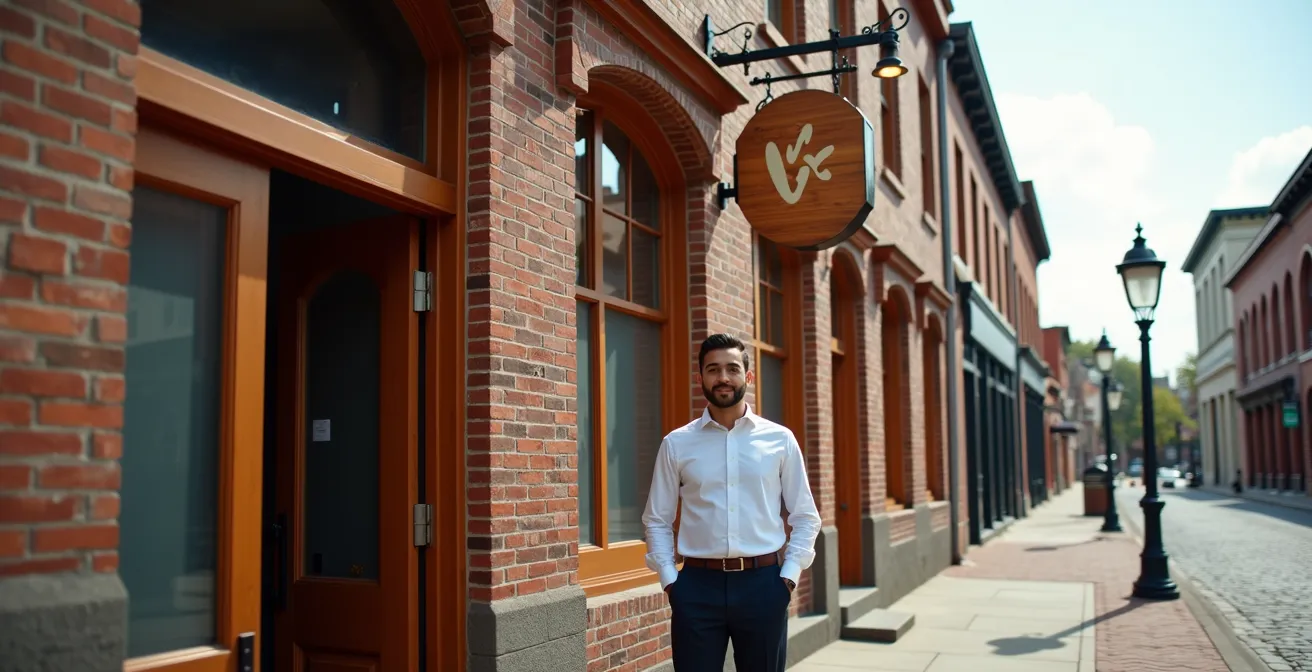
By embracing these limitations, you turn a legal headache into a powerful marketing story. Your location becomes “the franchise that respects our town’s history,” a point of local pride. This collaborative approach demonstrates a long-term commitment to the neighborhood fabric, earning you a level of goodwill that no standardized storefront ever could.
Your Action Plan: Navigating Local Zoning Compliance
- Conduct a proactive zoning audit before signing any lease agreements to identify all local ordinances, sign codes, and architectural requirements.
- Create a compatibility report flagging potential clashes between local bylaws and corporate brand standards, highlighting points of friction.
- Negotiate ‘Look & Feel Waivers’ with the franchisor for non-core brand elements while preserving critical identifiers like logos and key colors.
- Document how embracing legal restrictions can become a unique marketing feature, framing compliance as a sign of community respect.
- Engage local legal advisors or architects who are deeply familiar with the specific municipal zoning laws and approval processes.
When to Deviate from the National Calendar to Align with Local Festivals?
A franchise’s national marketing calendar is a well-oiled machine, meticulously planned around major holidays and seasonal trends. It provides a steady drumbeat of promotions designed for broad appeal. However, for a franchisee in a niche market, this national calendar can be woefully out of sync with the local rhythm. Promoting a generic “Summer Kick-Off” sale when your town is entirely consumed by its historic, century-old Founder’s Day festival is a missed opportunity of epic proportions. True local integration means knowing when to strategically deviate from the national plan to ride the wave of local energy.
This isn’t about ignoring the corporate calendar entirely, but about overlaying it with a hyper-local event map. This map should include not just major festivals, but also high school homecoming weeks, the start of the local fishing season, the annual town-wide yard sale, and other “emotional high” moments that define the community’s year. Aligning a small, custom promotion with these events generates far more engagement and goodwill than a generic national campaign ever could.
The data on this is clear. A targeted promotion aligned with a local event creates a powerful sense of relevance and community participation. This approach requires more local effort—coordination, custom signage, and staff briefing—but the payoff in both customer engagement and revenue is substantial, justifying the move away from the simpler, corporate-provided campaign.
The following table breaks down the typical impact of different promotion types, making a strong case for prioritizing community-centric events over a sole reliance on the national schedule.
| Promotion Type | Customer Engagement | Revenue Impact | Implementation Complexity |
|---|---|---|---|
| National Holiday Promotions | Moderate (25-35%) | Standard baseline | Low – Corporate provided |
| Local Festival Alignment | High (45-60%) | 15-25% above baseline | Medium – Requires adaptation |
| Community Event Tie-ins | Very High (55-70%) | 20-30% above baseline | Medium – Local coordination needed |
| Emotional Highs Calendar | High (40-55%) | 10-20% above baseline | Low – Simple rebranding |
The School Night Fundraiser: Why 20% Donation Nights Are Your Best ROI?
Of all the community engagement tactics available to a franchisee, the “School Night Fundraiser” or “Donation Night” is arguably the most powerful and efficient tool for building a hyper-local customer base. The concept is simple: on a designated evening, your franchise donates a percentage of sales (typically 15-20%) generated by supporters of a specific local school, sports team, or non-profit. While it may seem like you’re just giving away margin, the return on this investment is multifaceted and profound.
First, it’s a highly targeted marketing event. The school or organization becomes your marketing partner, actively promoting your business to its network of dedicated families through newsletters, social media, and word-of-mouth. This is an endorsement from a trusted community source, carrying far more weight than any paid advertisement. You aren’t just reaching potential customers; you are reaching the *right* customers—families who live, work, and socialize in your immediate area.
Second, it fills your location on what might otherwise be a slower weeknight, boosting baseline revenue while creating a lively, positive atmosphere. Families come in groups, see their neighbors, and associate your brand with a fun, purposeful community gathering. This experience forges a powerful emotional connection. Your franchise becomes the place that “helped our kids get new uniforms” or “funded the school’s new library books.” This narrative transforms your business into a genuine Community Keystone. As one franchisee from Apex Leadership Co. notes about their school-centric model, the impact extends beyond just the bottom line.
Finding out about Apex franchise ownership couldn’t be easier. I love the impact we have with the students and the community but my personal favorite is the impact we can have with the employees.
– Apex Leadership Franchise Owner, Apex Leadership Company
Finally, the ROI isn’t just in the immediate sales. It’s in the long-term loyalty you build. The families who came for the fundraiser are now far more likely to choose your location for a regular weeknight dinner or weekend treat. You’ve removed the friction of their first visit and replaced it with a positive, memorable experience. When measured in terms of customer acquisition cost and long-term value, the 20% donation is often the most effective marketing dollar you’ll ever spend.
The Rogue Tweet: Why Your Funny Local Post Might Violate National Brand Guidelines?
In the quest for local relevance, social media seems like the easiest win. A quick, funny tweet referencing a local high school rivalry or a meme about a town-specific problem can generate huge engagement and make your franchise feel authentic and plugged-in. This is the “Rogue Tweet”—a piece of content that is perfectly attuned to the local sense of humor but exists in a grey area of corporate brand guidelines. And this is where many well-intentioned franchisees get into trouble.
National brand guidelines for social media are typically conservative. They are designed to minimize risk across hundreds or thousands of locations, avoiding any topic that could be controversial, political, or even slightly off-color. Your brand’s voice is meant to be uniform and safe. The problem is, “safe” is often synonymous with “boring” and “corporate.” A feed that only posts polished, pre-approved marketing content will be ignored by a local audience accustomed to more personal and spontaneous online interactions.
The danger of the rogue tweet isn’t usually the content itself, but the precedent it sets. A funny, harmless post might go viral locally, but it could also be misinterpreted by an audience outside the local context or seen by corporate as a slide into off-brand territory. This can lead to a clampdown on your social media privileges, stripping you of a powerful tool for local connection. This is the tightrope walk of strategic non-compliance: pushing the boundaries for local impact without breaking them entirely.

The solution lies in proactive communication and establishing clear “Tone of Voice” parameters with your corporate marketing contact. Instead of asking for forgiveness, seek alignment beforehand. Propose 3-5 pre-approved local content themes (e.g., celebrating local student achievements, spotlighting community partners, behind-the-scenes with staff). Create a “Tone Thermometer” that shows examples of what’s on-brand (warm, celebratory) versus off-limits (sarcastic, political). By establishing these guardrails, you create a safe space to be creative and responsive to local moments without risking a call from headquarters.
Key Takeaways
- True local adaptation is about becoming a “Community Keystone,” not just applying a local marketing skin to a global brand.
- Strategic deviation from corporate standards in areas like service scripts, marketing calendars, and even architecture is often necessary for deep market penetration.
- High-ROI community engagement is targeted and participatory (like school fundraisers), creating tangible value rather than just passive brand awareness.
Guerilla Marketing in the Suburbs: How to Win Your Neighborhood Block by Block?
Guerilla marketing often conjures images of edgy, urban street art or large-scale flash mobs. For a franchisee in a suburban or niche market, however, the principles of guerilla marketing—unconventional, low-cost, high-impact tactics—are incredibly relevant. The “battlefield” isn’t a downtown metropolis; it’s the local farmers’ market, the neighborhood cul-de-sac, and the digital community forum. The goal is to create moments of surprise and delight that generate powerful word-of-mouth, winning your neighborhood block by block.
Suburban guerilla marketing is about hyper-local presence and generosity. Instead of a costly billboard, it’s about showing up at the starting line of the local 5K race with free branded water bottles and a cheering section. It’s about partnering with a non-competing local business—like a popular boutique—to create a “Shop & Snack” cross-promotion. As noted in guides to local store marketing, participating in low-cost events like street fairs provides excellent exposure and direct customer interaction without a significant budget.
The digital realm is also ripe for guerilla tactics. It’s about being an active, helpful member of the local community Facebook group, not by spamming promotions, but by answering questions and offering solutions. For example, if someone asks for recommendations for a last-minute kid’s birthday party venue, you can chime in with a helpful offer. This strategy taps directly into local search behavior. With research showing that 72% of consumers who perform a local search visit a store within five miles, being the top-of-mind, helpful local option is paramount. Your goal is to be the answer before the question is even typed into Google.
Ultimately, winning your neighborhood block by block means shifting your focus from “broadcasting” your brand to “embedding” it through acts of service and genuine participation. These small, consistent, and unconventional efforts accumulate over time, building an unshakeable foundation of local loyalty that no national advertising campaign can replicate.
To truly succeed, you must move beyond the role of a simple operator and become a community strategist. Start today by identifying one local ritual or event you can align with and one corporate standard you can strategically adapt for greater local resonance.